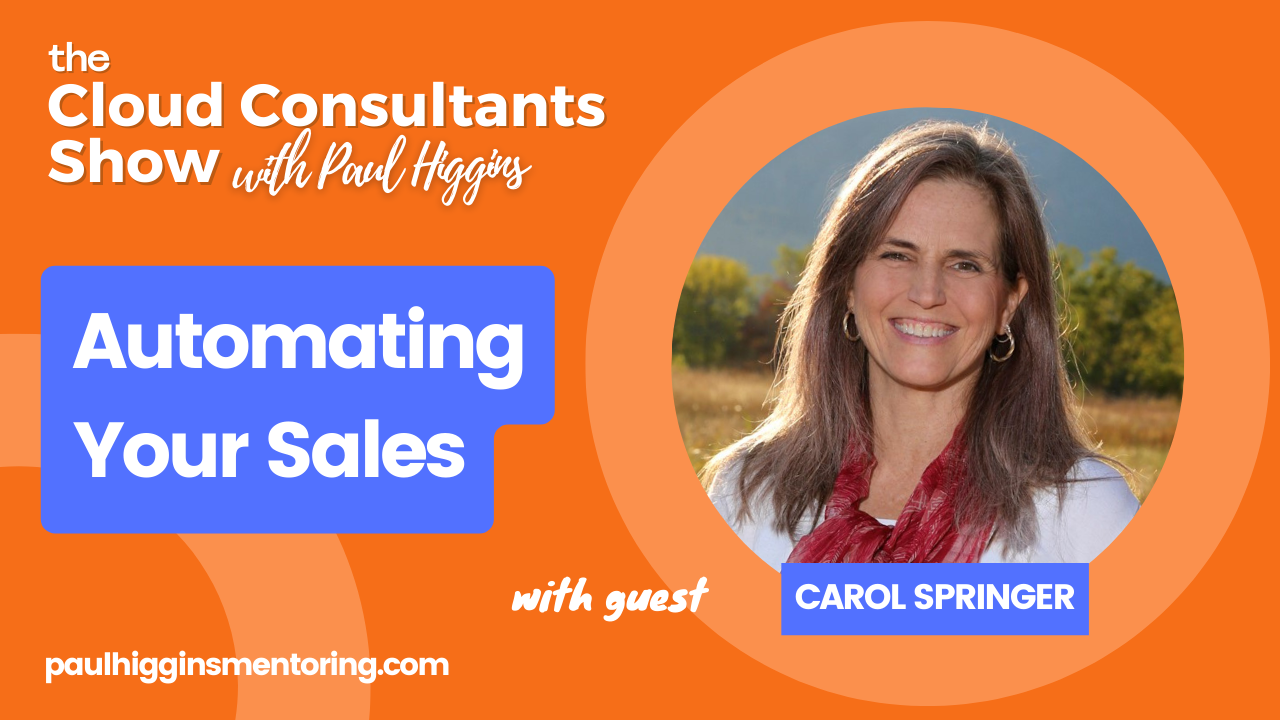


483 - Automating Your Sales with Carol Springer
Episode Overview
Are you automating your sales process?
In this episode, Carol focuses on the role of automation in sales. She emphasizes how you can expand your Salesforce practice with Pardot - a powerful marketing automation tool. She also highlights how it can be used for effective lead generation and nurturing and to deliver comprehensive solutions to clients.
Key highlights
- Carol’s ideal clients and the problems she solves for them, focusing on maximizing the use of Pardot, a marketing automation tool. She also mentioned the importance of understanding both Pardot and Salesforce, and the potential for collaboration with other Salesforce partners to provide comprehensive solutions for clients.
- The use of automation in sales processes, particularly using Pardot for lead generation and nurturing. They also talked about the effectiveness of LinkedIn for finding potential clients and providing value through content.
- Various strategies for generating leads and clients. They talked about using LinkedIn to repurpose newsletters, leveraging Upwork for smaller projects, and utilizing YouTube to provide value through training videos.
- Carol's experience as a Salesforce partner and her strategies for scaling her business. They also talked about the importance of creating content, staying informed about industry trends, and finding a balance between professionalism and authenticity when interacting with clients.
About Carol Springer
Carol owns and leads Gabriel Sales, a Marketing Automation agency and Salesforce Partner. In her role, she is a highly sought-after certified Salesforce admin and marketing technology consultant, working with companies of all sizes to help them leverage the power of Pardot and Salesforce to achieve their marketing and sales goals. Her deep understanding of the technology, ability to deliver results quickly, and passion for helping companies succeed have made her a trusted advisor for Pardot and Salesforce users.
When not taking clients to the next level, she loves mentoring new trailblazers; other hobbies include slow travel, yoga, hiking, and producing her travel and remote work podcast “Where Next?”
Resources and Links
- Gabrielsales.com
- Carol's LinkedIn profile
- Carol on Twitter: @CarolSpringer
- Carol on Instagram: @carol_freelance_life
- Carol’s Upwork profile
- Podcast: Where Next? Travel with Kristen and Carol
- YouTube channel: Sales Tech by Gabriel Sales
- Upwork
- Book: Lead the Field by Earl Nightingale
- Humantic AI
- Cloud Consultants Collective
- Scaling Blueprint
- Join our newsletter
- The Cloud Consultants Show
- Paul Higgins Mentoring
Automated Transcription
Please note: This is an automatically generated transcription. There are typos and the system may pick words or whole phrases up incorrectly.
Intro: I’m Paul Higgins, an ex-corporate executive turned business owner who, for five years, struggled to grow a cloud Consulting business whilst battling a chronic disease. With the help of mentors and experts, I got the business model right, built a sales and marketing engine, and developed a high-performing team that ended in a successful exit. I received a kidney transplant from a mate, and now on my second life, I dedicate my time to helping other Cloud Consultants go quickly with less effort to enjoy life. Detecting an accent, I'm an Aussie working globally from Melbourne, Australia. I interview successful Cloud Consultants sharing their scaling story to give you inspiration and practical tips. I have dedicated experts for Cloud Consultants on the show to save you time and money by working with the right people. If you want to scale quickly with less effort to enjoy life, you're in the right place. Let's get started.
Speaker 1 (0:55): Hi I'm Paul Higgins and welcome to the cloud consultant show episode number 483. Today's topic is expanding your Salesforce practice with Pardot, and you will learn how Salesforce and Pardot can work seamlessly together. So there's some great examples given on how you can do that and it's just incredible how little of the Salesforce users actually use a powerful tool like Pardot, how or who it really fits beautifully for. So there's some great examples of that. And then also some excellent examples of how you can use content to grow your cloud consulting business as our guest today has done for theirs.
Speaker 1 (1:35): If you're a first-time listener, welcome. If you're loving what you hear, please subscribe. It's for cloud consultants, people that consult and deploy a SaaS platform. And so if that's you, you're in the right place. If you're a regular, thanks for constantly listening or watching the show. Why don't you give me a bit of a shout out? Email me at paulahigginsmentoring.com, tell me that you are a listener or a watcher and also tell me what topics you'd love to get covered. There'll be something in the app that you're listening to and you can get full transcript and more notes at paulhigginsmentoring.com/podcast. It's episode 483.
Speaker 1 (2:11): And I also like to thank our sponsors, the first is the Cloud Consultants Collective. It's the world's only revenue focus collective for cloud consultants. It's peers answering questions for peers. And forget Google, forget YouTube. Come and get quick answers on Slack for free. Just go to the cloudconsultantscollective.com to join for free today. Andthe other is Workflow Academy, your top performers feeling overwhelmed by their workload. Do you worry that their performance is suffering or even worse, they might leave. While we've got an innovative solution for you, we've partnered with Workflow Academy to provide highly trained junior talent to support your top talent within your business. You can find out more at paulhigginstmentoring.com/WFA and let us help you achieve your business goals faster.
Speaker 1 (3:01): And our guest today's a lifelong learner for sales and marketing automation. Had an agency for outsourced sales and marketing, really enjoyed Pardot and how that could complement. So it was about half the cost of what a person was. So they went down a rabbit hole on that. Now they're a world's expert on Pardot, and they also help salesforce partners to help their end clients to bring sales and marketing together more because we all need more qualified leads in our business, and this is a great way of doing it. So what I'll do now is hand you over to Carol Springer from GabrielSales.com. Great to have you here, Carol.
Speaker 2 (3:41): Hi, Paul. Thank you so much. I'm so excited to be here. Appreciate it.
Speaker 1 (3:45): Yeah, look, really excited to dive into your story today, which is an exciting one. And I know you've had quite a, a change of, of late, but why don't we start with who your ideal clients are and what problems you love to solve for them?
Speaker 2 (3:57): Sure. Okay. So I am a salesforce certified consultant with a focus on Pardot. So Pardot is now called account engagement, which is the marketing automation tool that Salesforce owns and sells their clients for marketing automation. And my ideal client is someone that has Pardot and has not really maximized it yet. So that's a big thing. People buy these tools, they think, oh, it's probably just like mailchimp or something - it's not. It's like mailchimp on steroids 100%. So there's a lot to know. And a real ideal client is someone that has worked with someone else before and they couldn't really cut it for them. And so I think probably the one thing that really makes our company and my expertise is really unique is that I understand both part-aw and salesforce. So I understand marketing and sales and like Salesforce administration. And a lot of often product consultants don't really understand the whole salesforce side of things and salesforce admins often don't understand marketing whatsoever. So it becomes a big challenge. So some of them can really appreciate that I understand both sides is definitely the ideal client.
Speaker 1 (5:10): And you know when another partner's been in and they haven't been successful with Pardot and getting the result they want, what are the common themes like what do you see?
Speaker 2 (5:18): Usually not understanding how the two databases interact with each other, like how come my leads aren't going into salesforce it's a very common one and because you didn't assign them to anyone. How do I do reporting? How do I find out which ads or forms are creating the most opportunities, which ones are getting my return on investment? You ask typical salesforce admin about return on investment, it's going to be pretty challenging. So Yeah, I think it's mainly about how the data flows. And just like what are all the sections within the system? Like what is the page action? What's a customary direct? Like do I need this? Why is it even in there? And then a lot of times, Pardot just rolls out new features all the time. And knowing if it's, you know, is it turned on? Can I use it? Do I have permission to it? Probably that's the biggest thing is, like just not understanding the tool. A lot of people will buy Pardot and they use it just as the emailing tool. But it's so much more robust than that.
Speaker 1 (6:18): Yeah, and then what is that so much more? What is that?
Speaker 2 (6:21): Well, it can track all the visits of the cookie prospects on your website. And I'm surprised how many clients didn't know that was a feature. And so if someone fills out of form and then hits seven pages on my website, Pardot, can read all those seven pages. And then you can score each page, for example. And then you can run rules if someone hits 120 points because they hit these two key pages. Now, add them to a Salesforce campaign or notify the sales representatives, create a task in Salesforce. It can do a lot.The big thing that I help people with is, a lot of people when they're sending out emails, they will just import a list. And sometimes they'll pull a list out of Salesforce and import it into Pardot. But these two systems, they talk to each other. And so we were like, how can we make this a dynamic list? So you never have to import and export again. Or should they export and then import? And so teaching people that in what fields can hard-off read inside of Salesforce? They can't read everything. Can't read custom objects, generally speaking. And so. I just tell them this is where you need the data to show up and once you get that data to show up in the detail section of your lead or account or contact then Pardot can look at that and then create these lists real time for you. And I say that is probably one of the greatest features of the system as you can say to you a ton of time.
Speaker 1 (7:52): And this question might not be able to answer that. How many people that are using salesforce are actually using Pardot?
Speaker 2 (8:00): Just a fraction. I've had a guess I would say five percent, you know. So the salesforce universe is so huge and I started out as a Pardot expert because in our outsource sales business, we added that as in additional feature because we used to do a lot of cold calling and we said oh we need to use marketing animation and so we became marketing automation experts and then just really in private the last three years, you know one thing I realized is oh my gosh, how much could my business open up if we offer Salesforce services, right? So many more companies use Salesforce and Pardot. But with that, so much more competition, right? Not a lot of Salesforce admins know Pardot, but a lot of Salesforce admins know Salesforce, right? And so now even though my audience is bigger, my competition is much greater as well. But I still think it's a good thing. And I want, you know, definitely more and more Salesforce.
Speaker 1 (8:56): Yeah, and one of the reasons I brought your honest is I'm assuming there's an opportunity for Salesforce partners and Salesforce freelancers that have got a client that have the needs of Pardot can solve, but they don't want to be a Pardot expert, right? They don't want to go outside of the core that they do. So I'm assuming there's some complementary benefits of working with other Salesforce partners to get the end client result. Have you seen that play out?
Speaker 2 (9:22): Yeah, so I do work with one Salesforce partner and they are more of a, you know, subcontract. So when I go for the really hard stuff, we want to do some flows and some API integrations, I bring them in because that's I don't have a lot of back on staff. But I'm continuing to build up my network. And also I do have a lot of in our teams. We have sales operations expertise goes very well with Pardot. Pardot is marketing automation, inbound leads, outbound nurturing. But then what do you do with those leads to toss them over to Salesforce and then, you know, there's this battle between marketing and sales all the time. The leads suck. You're not following up with my leads, you know, it's a little bit of both typically. So I try and make both teams accountable and how do you actually set that up? How does marketing know if sales actually followed up with that? We can set that up with reports and say, okay, here's all the leads you brought in. Here's how we were converted. Here's how long it took to convert. Here's, you know, what stage they were at. Here's the reason why I didn't move forward. And so both teams are learning all the time from each other.
Speaker 1 (10:32): And is there any particular minimum, whether it's, you know, turnover, employee, can, is there anything that you look at from a, you know, is this company the right fit for Pardot, like, you know, what sort of indicators are you looking at?
Speaker 2 (10:46): Well yeah, it is really small companies probably can’t afford it. But I've actually had clients under a million dollars purchase it because it can actually replace. So we did an experiment once when we were doing cold calling. So we had two full time cold callers doing lead generation. And then we also had Pardot going and we saw Pardot generated about two leads a day. And the cold caller generated about two leads a day. So running Pardot, maintaining it, was about half the price of a cold collar. So I say Pardot is a half time sales resource. So there is one way that you're automating your sales process. Because you already have the list, and it's this series of email that goes out to educate, and it's the beauty of its consistent, right? So here's what we do. Oh, and here's the use case of our product. Oh, and here's the industries that we work in. The same thing as salesperson would have conversations about. Now you can automate that. And I'm sure everyone listens to this. It's a plethora of emails that are cutesy and these, oh, hi, did you get my last email? We like to stay away from those that are trying to like just pressure people into appointments. But instead make them more, oh, here's education, you know, and then people will unsubscribe. And if it's just not their need, then that's not their, it's not if it's not a fit. But people that don't unsubscribe, you know, you just keep giving them a little bit more and, they'll eventually make a decision, possibly move forward and then, you know, have a call to action to like book a meeting. So we can do that all automated. That's huge.
Speaker 1 (12:28): Yeah, and we'll sort of get to the love hate relationship with automation in a moment. But if you look at sort of industries, is there any particularly theme of industries where you've seen Pardot work really well?
Speaker 2 (12:41): I've seen definitely tech industries, and health care, like health care related, like, I have a couple health care software companies. So they're in the, they, their software serves doctors. And so, and then I have a medical device company as well. So I actually had to go through my little HIPAA training there, which is our, you know, patient health information protection here in the States. So I've seen that. I've seen realtor's use it. I've seen manufacturing, a lot of manufacturing. companies. So it's pretty widespread. But I would say people that, you know, it's business to business for sure. And they have a pretty decent ticket size.
Speaker 1 (13:28): Yeah and I know, you use it yourself to grow your own agency, right? So how are you using a combination of, you know, for you to grow the business and have different lead sources, right? One of them is this automation. So I know I've worked with a lot of Salesforce partners and you may be one of them that I'm working with at the moment listening to Carol today. Like, how do we sort of use that? Because it's funny, it's like the plumb of the leaky tap, right? Where there's a lot of Salesforce partners that just rely on Salesforce themselves to bring them leads. And you know, at the moment, we're recording this and it's going to be released in July of 2023, Salesforce is going to through some massive changes, there has been a lot of AEs that have been let go or are looking to go and therefore the consistent leads that you've got as a salesforce partner might not be there at the moment. Right. It's not everyone but I know some of them really impacted. So people are saying, hey, I need to self-generate and a great option to self-generate is to do outreach, the way that you've been doing with Pardot. So take us a little bit through.
Speaker 2 (14:34): So this is the very, very tricky part because outreach should be the people you have a relationship with. It is a no-no to start cold emailing out of Pardot. Pardot is for opt-in and leads. So that is and I've had people like, well, how do you get them adopted? If you can't email them like, well, got to do advertisement, you've got to go to trade shows. But for smaller, you know, organizations, cloud consultants, networking is huge. And that's why it's not an overnight success by any means. So I've been active in LinkedIn for 20 years. I've been on Twitter, just had my 13 year Twitter anniversary. Can't say I get leads from Twitter. I think I've gotten a candidate from Twitter. And then I went to Upwork, which is website that you go. It's like freelancer.com. Many people, it's pretty big now. Many people have heard of it, but it's where you go to find freelance work. So I do a lot of Upwork jobs. And it's a lead gen tool. And at this point, I have such a great reputation there. I've got five star ratings that people just come to me. And I get to choose who I want to work with. But it's pretty awesome. It's kind of hard to get started, but I am a salesperson at core. So that is really helpful. If you're trying to grow your salesforce agency and you don't like sales, you need to find someone that does. Or you need to partner a VS subcontractor under someone. Like I mentioned, I work with another salesforce agency. Their groups aren't really interested in sales. They're really good at what they do. So they just get a lot of referrals. And the main gentleman there loves working with us because we bring him just new stuff that some people have a pigeon hold into just API. But we do these interesting flows in introducing sales operations and campaigns where we still need his help. And so he really appreciates that.
Speaker 1 (16:27): Yeah. So just to summarize, the key thing is someone's got to be obviously opt in and different countries have different standards. So just make sure that they're the. And, you know, once they're off then, then you can use the automation on a nurture sequence, which we're all sort of fairly familiar with. But as you said, to get people on the list in the first place, you know, you use LinkedIn and you use Upwork as sort of two key ways. Linkedin, so, this will be posted on LinkedIn. You probably may have picked up this interview with Carol through the LinkedIn posts that we're doing. And they tell us, you know, what's working for you on a LinkedIn perspective? You've been doing it for what you say 20 years. So you've had lots of practice. What's working for you right at this point in gaining new clients through LinkedIn or gaining people onto your list, which now often people say, I've got all these connections on LinkedIn. But, you know, then if I look at my email list, there's no one, there's crickets, right? How do we sort of convert the data?
Speaker 2 (17:25): Yes. So there's a few ways. One, I go into, I look at the jobs. So I'm going to share my trade secrets here. I learned this from working at a staffing company. It was a ways to do accounting staffing back many years ago. And how we found leads, we found people that were looking for accountants and we would call and say, hey, do you want to hire a talent? Well, while you're hiring someone, we don't use stamps. We don't use stamps. Eventually, they'll call you back if you talk to them every month. They're like, hey, we actually need some help right now. Do you have someone that knows Peachtree or whatever the accounting system is? So I took that method and I go into LinkedIn and see who is hiring for Pardot, jobs that have Pardot in there. And then I connect with those people and then I'll send them messages through LinkedIn. And then if they connect with me, then I'll add some of those people to my list if they are engaging in a conversation. So I start the relationship on LinkedIn, but then continue it. So they're in my database now. And some people that don't want to engage, I still reach out to them on LinkedIn from time to time, maybe once a year through DM and Inmail. And now I'm promoting my YouTube channel. So that's one thing that I've built. And so I'm providing value to the audience. So that is huge. And that's what you need to do on LinkedIn. I'm sure you understand that. And I'd probably share that. It's not just about connecting and just waiting for someone to say, oh, I have a job. And it's the first one to jump on it. You have no relationship with this person. So just providing value. And I post, I probably post this about once a month, not tons. But it's usually a video. Or here's a video I found a lot of people are having this problem with importing or whatever. So here's a video I made. And if this you resonate with this, go ahead and watch it. And then try to get them to subscribe to the YouTube channel. And I think I've gotten the whole time, like two leads, you know, 10 years from actually YouTube. Very low conversion rate. And of the leads that I've gotten from LinkedIn, it's primary people that I've had some conversation within the past. So I actually did get three deals last year from LinkedIn that were cold outreaches through the direct messaging. They weren't the best deals. They were okay. But maybe they'll need a full-time person or a bigger job in the future. So this business, people come and go, oh, we're good, Carol, because usually what happens, they hire our team to help them learn the system because they thought it would be easy, but it's not so easy to learn. It's not intuitive. But once you figure it out, it's like, basically when you're learning new technology, you have to basically train yourself to see how it thinks. Do I have to do this first or this first? And once you get it, one thing that we do all the time is create playbooks and standard operating procedures for clients. And I do some of that for my own outreach and LinkedIn posting. We're always want to make sure we cover this topic, then this topic, and then we just rotate those six topics, you know, once a month and so, and then there should be a video, and then it should be just a normal blog post. I haven't really done too much of like creating my own social posts in, or you do, you can create blogs inside of LinkedIn. I've done it a few times, but not a big strategy.
Speaker 1 (21:00): Yeah, look, and we've just started doing that again, and they've changed the algorithm newsletter, and I recommend you have a look at it again. You and you listening or watching, because, you know, like, for example, we're getting, you know, I think I've got four, just, just under 5,000 subscribers to the newsletter, and I'm getting around 1,300 impressions a week, and I'm actually getting people to open the newsletter about 300 now. When I say that, we've done it for two weeks. So, already.
Speaker 2 (21:32): And this is on all on LinkedIn? The newsletter is on LinkedIn?
Speaker 1 (21:36): This is all on LinkedIn. So, yeah, so what I'm doing is taking my newsletter that I would give to my subscriber list. I'm taking that and then I'm repurposing that on LinkedIn. And that is getting a really good traction. And the benefit of it is that all of your subscribers get notifications that your newsletter is going out. So, it's another great way of getting a touch point through LinkedIn. So, I definitely look at the newsletter.
Speaker 2 (22:01): Oh, thank you. I didn't even know that was a thing. Oh, my goodness. Okay.
Speaker 1 (22:06): Yeah. And a bit of a shout out to John Nemo, who's a past guest of the podcast. He did an interview on it and did a podcast interview on it and it was, yeah, we've been doing it.
Speaker 2 (22:14): Okay. I will listen to that one for sure.
Speaker 1 (22:17): I'm two weeks in and it's working great. And so just on the messaging. I know. that, you know, for us, we split test no message versus message to see what works best just for ourselves and also for the clients are workful. What do you find? Do you always personalize a message when you send a connection request or sometimes you just send a connection request for that?
Speaker 2 (22:37): I typically do not send a message with the message request. And I tend to decline those that I don't think are a fit.
Speaker 1 (22:46): Yeah. And look, I think it's where your profile does all the heavy lifting for you, right? So, you know, sometimes if you're sweating on like, have I got the right message or not? You know, we've found that, you know, you're nearly getting the same acceptance. Oh, okay. So it might be up to 40% acceptance is sort of the gold standard. We get slightly under that. But just by sending a no message connection request, because they will go and look at your profile. Right. And then the profile does all the heavy lifting. And I think if you look at Carol's profile, it’s great example. She's been there for 20 years. She's constantly perfected it. That'll do the heavy lifting for you. So I think that works. And then once someone's engaged with you on LinkedIn in direct message, do you automatically add them to your list or you're asking for permission to add to your list?
Speaker 2 (23:36): Well, a little bit of both. Kind of depends on the person because I also connect with a lot of candidates. And so they usually want, their hungry and they'll like, they're thrilled that I connected with them. So I'll add them. And then, you know, sometimes I'll try to like send them a message directly first through my email before I put them into Pardot. So you don't want to just send ice cold people in there.
Speaker 1 (24:00): Correct. And it's once again, it's up to who you're working with, etcetera. But the terms and conditions of LinkedIn do say that once you put your email address on LinkedIn, the terms and conditions on LinkedIn is that can be used for marketing purposes.
Speaker 2 (24:15): Oh, okay. I didn't realize that.
Speaker 1 (24:17): Yeah, so it's, but once again, it depends on your audience. And I personally like to ask people rather than just directly do it, but you can do it. So that's the LinkedIn component of it. Like you said, you use Upwork and Upwork to then, as I understand it, to upsell into a client base. So you're taking people off Upwork as a direct client. Is that the strategy you're using with Upwork?
Speaker 2 (24:41): No, typically the fact that I find them on Upwork will stay on Upwork for most of the time. And Upwork as an incentive actually to do that. They are changing it now. Like the commission that they take goes down dramatically after a certain length of time. and I just look at it - It's a cost to sale. And my close ratio is so interesting. So. I still would say LinkedIn is my top leadgen tool. Even though I, if we look at volumes of clients, I have a lot more in Upwork. But my bigger clients, my high quality, my retainer clients, they came from LinkedIn. And they were usually from people that I had some interaction within the past. So it's not cold people. So again, it's really important to build that relationship. And then Upwork, volumes volumes for people at a 15 hour project, and you know, it depends on my mood. You know, if I'm kind of slow and I see some of my people aren't super busy, then I'm like, oh, it's like a 15 hour project, because, you know, why not? And, and it could turn into a longer term project.
Speaker 1 (25:47): Yeah, yeah. And I think it's, it's really smart. Like, two key things here that listen to Carol. So one is that, you know, if you're certainly just starting out on, you know, Salesforce partner or for that matter, any partner. And there is work on upwork, use that to, to generate the cash flow to build the business that is going to be larger clients, which is then using LinkedIn. So I think those strategies together work really well. If you're, you're starting it, if you're, you know, got to finally it's off your partner, I recommend that you also use LinkedIn to compliment those because as we know, which is happening right at this moment, that when Salesforce makes a huge change to their account executive team, all those relationships you've built can go by the wayside. So, you know, I think it's really good to have a combination of those. And YouTube, is it something that you're putting a lot of time and effort in Carol or is it sort of something that you know?
Speaker 2 (26:40): Not tons, but it's so interesting. I always preach, you know, just baby steps, do a little bit at a time, especially when it comes to marketing, because I have a whopping a hundred forty two subscribers to my, you know, hopefully more when you come check out at this listeners. And the first hunter took forever. And I did learn this one little secret when you share your link, you actually share the link that has the subscribe confirmation. So if they click on it, it's gonna say, are you sure you want to subscribe? And that has definitely upped my subscriptions significantly. But the views that I have, I'm kind of blown away. And again, I don't think I can ever monetize because the requirements are nowhere what I'm going to achieve in years, like 4,000 hours in a year, and I'm at like 500 hours in a year. And even if I dig into that point, I think it's pretty minuscule how much money you actually get. So YouTube, how I use it is it helps, it actually provides tons of value. So this could be for other consultants. It is not very fun to train people like, okay, go to the navigation. Oh no, next one over. Okay, now do pull down. It's going to be very patient. And it's really not the best use of my time or my consultant's time. So what do we do? Just watch the video, Mr. Client. And then we're going to work in your system and you're going to, you know, either the video is going to teach you exactly how to do it. And now we don't need to have a training session on it. So it's like they get free training. So it's a huge value add. I'm probably undercharging for, compared to some other people tell me, but what I'm trying to go for, I'm trying to go for those retainer clients. I want them to keep coming back every month and sign up for four months, six months, or a year. I've got several clients and I went client with for 10 years for that. You know, we were calling for them many years ago. And then, you know, a couple other clients, three years, two years. And so we're not a one and done project agency. We want that retainer business. And how we do that is you don't charge $200 an hour. People can't do that forever. But while you're solving a problem, it's great. And then some clients, I've actually, I have two training programs. One I have on a site called Podia. I put together, I just curated, here's all the Pardot training that you need. But I found the shortest video, the most distinct trailhead. And then I have some Word documents. So it's a self-service program. But what we find, a lot of people don't want to be self-service. So, but what I do, so if anyone hires me for at least a 30-hour project, they give them free access to that training program, which retails for $249. And then I just, in finishing up, a Udemy Pardot training program, much more professional. It's me talking live. We're walking through like 11 sections and that one, I'm not sure how much that's going to be. I'm working with you to need a party. I'll let them fix the price because they know what's going to give the most demand. And that is awesome. That took me a long, long time to put together and get the screenshots and have handouts. And it's a really nice Pardot training program. And I'm hoping it's going to produce some passive income.
Speaker 1 (30:06): Yeah, that’s great. And I think the big call out here is if you've got videos that you've given to your clients, those ones, consider on YouTube so they can do two things. You know, your clients can go and see that and they can also see other content. But also your prospects can also benefit from that as well. So you're actually serving two purposes rather than just having it buried in your own Google Drive or Dropbox, etcetera. which just one.
Speaker 2 (30:32): I love doing them. And most of them are just one hit. I don't edit them. I just record and post them up there. And so some of them are kind of goosy, whatever. But I think people like it. And one of my top one is 5,000 views and I've only done this for two years. So for me, that's huge. And like, wow, 5,000, you know, for some YouTube, that's not an advantage. But for what, you know, how niche this is, I think it's, I'm pretty proud of it.
Speaker 1 (31:00): Yeah, brilliant. Well, just a reminder, we're talking to Carol Springer. And it's episode 483. We're going to have all the links, etc. in the show notes. And we really, you know, talked about A - how you potentially as a Salesforce partner could be extending your customer experience by having Pardot. And if you are, you know, Carol, I think it's a great, great person to do that. And then if you're currently running a Salesforce business and you're looking to increase your leads, Carol's giving you some great options there around LinkedIn, around Upwork and particular around LinkedIn is going to see who's recruiting and then maybe following off the back of recruiting, which is a great little tip. I heard that in a podcast the other day and I thought, yeah, I've got to recommend that. So, Carol, well done for doing that first. So, what we're going to do now is go into the rapid fire. So, I'm going to ask you four questions, Carol, and get your rapid fire responses. Are you ready for that?
Speaker 2 (31:55): Yes.
Speaker 1 (31:56): All right, let's do this. So, the first one is, what are some daily habits that help you scale Gabriel Sales?
Speaker 2 (32:01): Well, I would say, not quite daily is them, you know, checking the Upwork jobs out there because they don't have Pardot new jobs all the time. So, that for sure. Social - I love Instagram and that's my daily one. So, I'm continuing to build my audience and they're not all Salesforce good, you know, clients specifically, but I engage with them. I follow more people all the time and I'm building up, I have a Gabriel Sales Instagram page, and I have a Gabriel Sales Twitter also. So just constantly following new people so they follow you back. And then, you know, again, it's just building that audience. It's how building, and then I'm really big into networking on Slack groups as well. I found that that was a big goal last year. I said, I don't, there's too much. Like, what do I do? You know, so I pick three Slack groups, and those are the only ones that I engage with. One's very part-not focused, one's Salesforce content creator focused, and then another one is just for the local university here. But, you know, just trying to get value.
Speaker 1 (33:08): Well we might get you there, which is a cloud consultants collective, but we'll talk about that a little later. But the next question is around, where do you find more information about scaling your business? Where do you go to research? You know, where are you learning from?
Speaker 2 (33:24): What I've observed over time and I've been tell this when people have needed our sales help to sales B2B sales follows I believe B2C trends and so, it used to be like if you're gonna buy a refrigerator or a new bicycle, you are not just gonna walk into any store and just buy it. You're gonna look online, you can zoom in reports, is gonna run forever, but you're just gonna look at the reviews and see you know what makes most sense. And that's happening with B2B and so with my travel podcast: Where next travel with Kristen and Carol, as I Do a lot of Instagram, I'm seeing what's working, what's not working, what's engaging. And so watching the B2C trends is what I see and then I talked to a lot of other podcasters, and what are you doing? What's working? What's not working? Aand I see that crossing over to B2B and then also I get information from books, but not the typical sales books. It's really about, I think, emotional intelligence is and being balanced as a human being because people want to work with people they like before agreements book. Stephen Covey, Earl Nightingale, Lead the Field, you know, just it teaches you that's probably the most salesy book. And then everyone's well, I'll pick up another book and my husband reads like crazy. So if there's something that he's like blank or whatever the latest book is he'll share with me.
Speaker 1 (34:53): Awesome
Speaker 2 (34:54): And podcasts. I'm not finding enough podcasts that are independent like this. So I'm just so excited that we connected. Thank you, Paul.
Speaker 1 (35:02): Yeah, brilliant. Well, the next question is one wish. What's one wish we can grant for Gabriel Sales?
Speaker 2 (35:08): If you could tell me where social media is going, like should I invest more time and effort into YouTube or, you know, is TikTok, I've never touched TikTok. Is that going away? I love to dance, but I don't think I would do it for my business right now. But yeah, if you could give that to me, that would be amazing.
Speaker 1 (35:29): Yeah, yeah. Look, I'd love that as well. And the last one is, what do you know now about running great Gabriel Sales and certainly running around the Pardot part of the business that you would share with the unknown earlier?
Speaker 2 (35:42): I think creating more content because that just takes a long time for it to develop. So I wish I would have started sooner because if I started, like I was training clients in 2012 on Pardot, like why did I not love that? You know, maybe I would be at that rate right now that I mentioned and just kind of keep doing, and then you got to find what your niche is like, you know, not everyone wants to do videos. I love podcasts. I want to find more podcast speaking engagements. I do run a one for fun, as they said, and I don't really have the bandwidth to create a whole other podcast. So I know it's a decent amount of work. You got to love it, right? I love the talking, but I don't like all the editing, the other stuff..
Speaker 1 (36:32): Yeah, well, yeah. And look at it all. That's why I've got a great team supporting me. There's a big shout out to them. But I think you're right. One of the key lessons is you've got content, right? You've already got content. You're just not publishing it, right? So it doesn't have to be perfect. And just remember that you've only got to be better than the person themselves that's trying to implement something, right?
Speaker 2 (36:54): Right. Yeah.
Speaker 1 (36:56): You don't have to be perfect.
Speaker 2 (36:58): And I know to the listeners, right. And people are buying from you and say, you've got to get them get to know you. But one caution I have is sometimes I get a little too silly and goofy with new clients, maybe they live somewhere, I've always wanted to live or I start cracking jokes and I swear 50% of the time I don't win those deals. So just when you first meet someone, I always put on the professional hat.
Speaker 1 (37:21): Yeah, yeah, true, true. It's a balance, right? It's a balance between being yourself and not crossing a line that makes people uncomfortable and reading what style of person is well. So, you know, I think there's some good software out there now that you can actually look at someone's LinkedIn profile and work out what personality profile they are and then matching.
Speaker 2 (37:44): Really?
Speaker 1 (37:45): Yeah, that's Humantic AI which we'll put in the show notes is a really good little software for that. But look, I know that we've gone a little longer but that's because you've created so much value but thanks for coming on today, Carol. And we wish you every success and there'll be more from me after we say goodbye to Carol.
Speaker 2 (38:05): Okay, thank you so much. We really appreciate the opportunity.
Speaker 1 (38:08): That was a great interview by Carol. There was lots of value in there. If you're a salesforce partner, I think Pardot might be a really good opportunity for you. So it carrel up for that, but also if you're just starting out. There's some great tips around using Upwork and using LinkedIn and Job Ads, etc, to generate more income for your own business. So why don't you share what you loved on Linkedin, give Carol a reach out. And also if yo’ve got peers that you know would benefit from this. Please share it with them. Check out our solo show. And also if you're scaling your cloud consulting business and want a great benchmarking tool, go to our e-book. It's completely free. You can go to PaulHigginsMentoring.com/blueprint to get your copy today or free copy and please take action to grow with less effort and more reward.
Outro: Learning is just one piece of the puzzle. it is now time for action. Head to Today's show page at paulhigginsmentoring.com/podcast, get the links, and put it into action. Head to your favorite podcast platform, subscribe, rate, and review the show. Suggest topics for me to cover at [email protected], and don't wait one more minute to gain access to content, especially for you, a cloud consultant at paulhigginsmentoring.com/newsletter. This could be the difference between wasting time figuring it out yourself or scaling quickly with less effort to enjoy life.