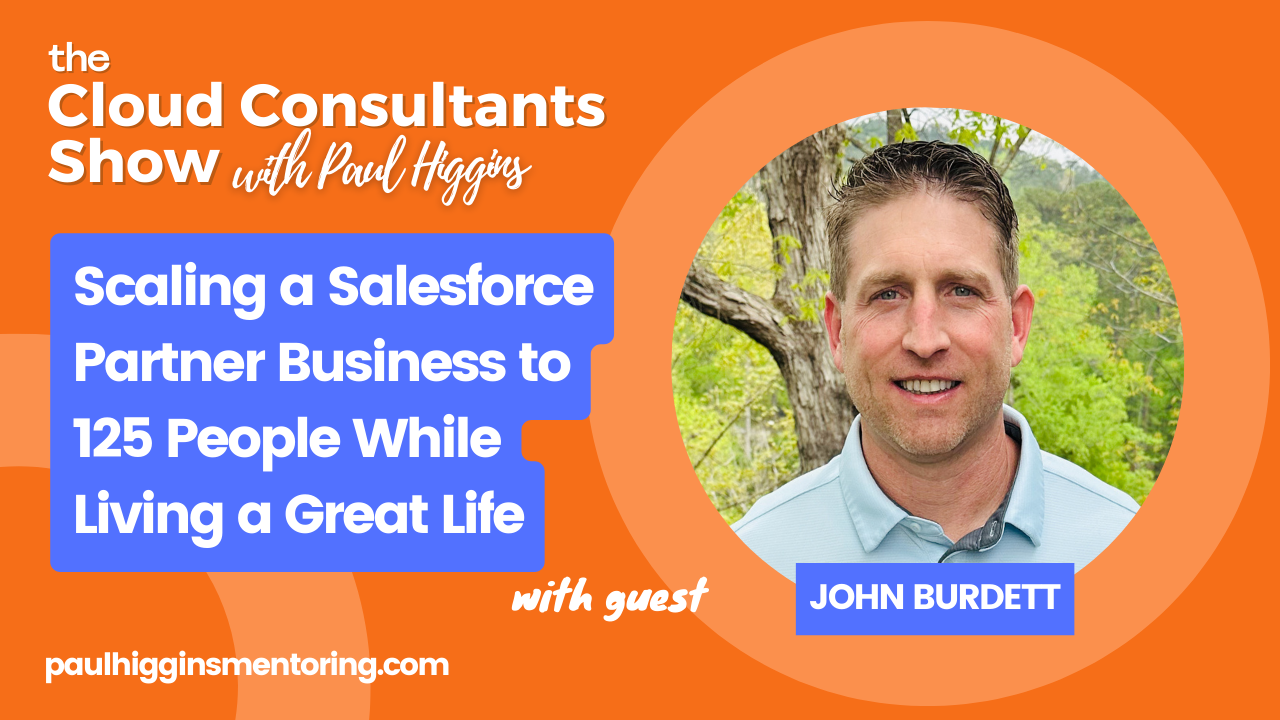


481 - Scaling a Salesforce Partner Business to 125 People While Living a Great Life with John Burdett
Episode Overview
Are you struggling to scale your business? Hiring people who are aligned with the core values of the company will definitely help you scale.
In this episode, John shares his expertise in helping businesses scale and improve their operations. He also gives insights into the proven and effective strategies and values that have contributed to their success in recruiting top talent and the overall growth of Fast Slow Motion.
Key highlights
- John talks about how he helps struggling businesses scale and professionalize their operations. They discussed the ideal client, the use of technology, the different Salesforce clouds they work with, and the high percentage of leads that come from Salesforce.
- The strategies and values that led to the success of John's business. They focused on serving and helping customers, aligning their processes with Salesforce's business model, and prioritizing employee happiness and flexibility.
- The measures used to evaluate employee performance, including metrics like hours logged, communication with customers, and happiness scores. They also talked about the importance of profitability for the company and how variable compensation plans are aligned with the core values to incentivize employees.
- The strategies that worked well for John's company in recruitment, including being intentional, using assignments to assess candidates, and having a director of recruiting who aligns with the company's values. They also mentioned learning from past mistakes and being influenced by experts like Patrick Lencioni and Simon Sinek.
About John Burdett
John Burdett is married to his wife of almost 23 years, Misty. They have a son Clayton (sophomore at Auburn University), and a daughter Kenna (freshman at Auburn University).
John is the founder and CEO of Fast Slow Motion. Fast Slow Motion focuses on implementing Salesforce and Hubspot for growth businesses. It is also one of the largest, highest-rated partners in the Salesforce ecosystem, focusing on growth businesses with clients and employees across the US and multiple countries. He's enjoyed helping grow businesses such as CTS, TicketBiscuit, and Hospicelink. He has a B.S. in Computer Science from the University of Alabama at Birmingham (UAB) and an MBA from Emory University.
He also co-founded Red Mountain Grace, a Birmingham, Alabama-based ministry that houses and serves out-of-town families needing medical care in Birmingham, Alabama.
Resources and Links
- Fastslowmotion.com
- John’s Linkedin profile
- Fast Slow Motion on LinkedIn
- Fast Slow Motion on Instagram: @fastslowmotionconsultants
- Facebook page: Fast Slow Motion
- Fast Slow Motion on Twitter: @fastslowmotion
- Redmountaingrace.com
- Patrick Lencioni
- Simon Sinek
- Cloud Consultants Collective
- Scaling Blueprint
- Join our newsletter
- The Cloud Consultants Show
- Paul Higgins Mentoring
Automated Transcription
Please note: This is an automatically generated transcription. There are typos and the system may pick words or whole phrases up incorrectly.
Intro: I’m Paul Higgins, an ex-corporate executive turned business owner who, for five years, struggled to grow a cloud Consulting business whilst battling a chronic disease. With the help of mentors and experts, I got the business model right, built a sales and marketing engine, and developed a high-performing team that ended in a successful exit. I received a kidney transplant from a mate, and now on my second life, I dedicate my time to helping other Cloud Consultants go quickly with less effort to enjoy life. Detecting an accent, I'm an Aussie working globally from Melbourne, Australia. I interview successful Cloud Consultants sharing their scaling story to give you inspiration and practical tips. I have dedicated experts for Cloud Consultants on the show to save you time and money by working with the right people. If you want to scale quickly with less effort to enjoy life, you're in the right place. Let's get started.
Speaker 1 (0:55): Hi I’m Paul Higgins ans welcome to the Cloud Consultants show, episode number 481. So today’s topic is scaling your Salesforce business to 125 people while living a good life. And you’re gonna learn some, lots of value, but three things that really stick out. One is his three core values to the business, and these aren’t lip service. The way that he articulates what he does is brilliant. The second is at risk comp model and he goes into the detail of what that is and how it varies across different roles within the business. And the third is his internal recruitment model to get to 125 people, but also how he uses marketing and some great tips there.
Speaker 1 (1:35): And if you're a first-time listener, welcome. And if you love what you hear, please subscribe. It's for you, a cloud consultant. So if you consult and deploy, a SaaS business or SaaS partner business, you're in the right place. And if you're a regular, I'd love to hear from you. Just email me at [email protected] say that you listen and also suggest some topics or maybe a guest, you might have want to be a guest yourself. Love for you to pay it forward. Do that. And there'll be a summary in the notes that you're listening to. So if you're writing or walking or whatever, you'll get those. And also the full transcript will be at paulhigginsmentoring.com/podcasts.
Speaker 1 (2:10): And before we go into the interview with John, I’d like to thank our two sponsors. The first is the Cloud Consultants Collective. It’s the world’s only revenue-focused collective for cloud consultants. So it's peers answering business questions for peers. Right. Don't reinvent the wheel. Don't waste your time on Google or YouTube. Just go to the cloudconsultantscollective.com and join free today. And the next is The Workflow Academy. Are your top performers feeling overwhelmed? And this could mean that they may, at best, underperform, at worst may leave. We've got an innovative solution where we provide top junior talent to work under your top tier talent. And it's a game-changing solution. You can find out more at PaulHigginsmentoring.com/WFA.
Speaker 1 (2:53): So our guest today is John. He;s the founder and CEO of Fast slow Motion. Fast slow Motion focus on implementing salesforce and HubSpot for growth businesses. It's one of the largest highest rated partners in the salesforce ecosystem. And it focuses on growth businesses and clients across mainly the US. He had the pleasure of growing businesses himself. He's a Got a Bachelor of Science in computer science from University of Alabama in Birmingham. And he's also got an MBA from Emory University. He also co-founded the Red Mountain Grace, a Birmingham, Alabama-based ministry that houses and serves out of town families needing medical care in Birmingham, Alabama. So what I'll do now is hand you over to John Burdett from fastslowmotion.com. Great to have you here, John.
Speaker 2 (3:42): Great to be here. Thanks so much for having me.
Speaker 1 (3:45): Yeah, look, I thoroughly enjoyed our conversation we had in preparation for this. So I can't wait for you to hear what John has got to say. He's built an amazing business and has a great life. And you're going to hear more about how he's done both of those today. But why don't we kick off with who your ideal client is and what problems you helped to solve for them?
Speaker 2 (4:05): Yeah, our clients, that client that's struggling to scale their business and they've started and created a real business. They've made it and they're really struggling to get to the next level or their business has turned out to be something that they didn't intend for it to be. So we love professionalizing businesses and help them really operationalize everything so they can get their life back and really kind of build their business with intentionality and focus.
Speaker 1 (4:29): Right. And is there, you know, any particular size like, you know, any employee size as a rough rule of thumb?
Speaker 2 (4:36): Yeah, it's typically smaller businesses that are wanting to grow is our sweet spot. We have clients all over the spectrum, but we do not like working with those large enterprise clients. We enjoy working with the smaller businesses. So they're typically 200 employees in less. It's usually our sweet spot that we have clients with five employees and we have clients with thousands of employees, but they have more that mentality of, I'm struggling to scale, I want to operate operationalize things and get better.
Speaker 1 (5:04): Yeah, yeah, brilliant, brilliant. And if you had to say like a mix between the people, the technology, and the process, what sort of you will mix when you work with clients?
Speaker 2 (5:15): Yeah, I would say we're right. The nice hybrid or mixture of all of those, we believe technology is a great tool, but it needs to be applied the right way. And it's really about solving business problems and making wise decisions with us. We like to challenge our clients and help them make wise decisions and help them understand the pros and cons of applying that technology. But at the end of the day, technology is fun. We enjoy getting our hands dirty, and we focus on delivering those results through the technology tools that we leverage.
Speaker 1 (5:45): Yeah, brilliant. And as far as the different clouds, so to speak, for Salesforce, which ones do you cover, which ones don't you?
Speaker 2 (5:55): Yeah, so we're primarily a Salesforce implementation partner. We're a summit to your partner. We do focus on what they would call lower mid-market and below. So those are lower mid-market, what they call growth business, GRB and then SMB clients, it's really our sweet spot. And we focus across all different industries and really all the different clouds. We have really experienced an expertise in everything from health cloud, financial services, cloud sales, cloud service, cloud, CPQ, FSL, experience cloud, so on and so forth. It's really if it's a tool and a platform that'll add value to our client base. in case we implement it. We do tend to stay away from the more expensive clouds, like commerce cloud and things of that nature, because the price point is too expensive for our customer base to purchase and then implement.
Speaker 1 (6:43): Yeah, and I know you started in circa 2014, so nine years and you've grown it to 125 people, which will get into the people side in a moment. But as far as multi-cloud, if we can call it that, is that where you started or did you start it in a couple of key ones and then sort of expand it from there?
Speaker 2 (7:00): Yeah, yeah, so we fundamentally believe of taking a holistic approach, and that's one reason we really like the Salesforce platform is you can run your entire business on it. Get all your data in one place, consolidate all your processes and minimize your integrations and things of that nature because that creates a lot of technology challenges for a lot of people. So Salesforce being the flexible platform it is, allows us to do that all in one place. However, usually we're either starting with sales or service cloud because usually, honestly, sales is usually what's broken. And if we fix the upstream processes, it helps the downstream processes and not vice versa. So we always come in with, you know, let's solve something small, add a lot of value very quickly, and then iterate on that over time with the goal of hoping to address all aspects of the business and get that professionalized and on a standardized technology platform that will scale.
Speaker 1 (7:55): Yeah, great. And what percentage of your leads come from salesforce themselves?
Speaker 2 (8:01): Yeah, very, very high percentage. We're very tightly coupled to Salesforce. As you know, they go to market with their partners from an implementation standpoint. Their technology is obviously very powerful as a result of that, creates a great opportunity for us consulting partners out there because the clients need professionals like us who have made all the mistakes. What things to look out for and can really guide them along the way. People that tend to self-implement and stuff like that typically don't adopt and typically fail. So it's a really nice symbiotic relationship that we have with Salesforce. So we invest heavily in that relationship. We spend a lot of time, resources and energy helping Salesforce sale, enabling their sales team, helping them guide the customers the right way so that not only the customers buy the right products and get the right solutions but then implement it the right way so that they're successful long term.
Speaker 1 (8:57): Yeah, brilliant, brilliant. And what are some of the rhythms, the behaviors that you have with Salesforce at the moment that you know you listening to John could learn from?
Speaker 2 (9:08): Yeah, so we really focus on serving and helping them. So we modeled our processes and systems about how they go to market and how they do things. So as many people know, Salesforce has a large direct Salesforce. They're the largest software company in the world that does have a direct Sales model all the way down to the lowest customer. So if you're a one-person business, you have a Salesforce account executive assigned to you and that's not normal in the software ecosystem. So a lot of times those companies will go to market through their partners and do that. Salesforce doesn't. So as a result of that, they have a large Salesforce and they have quite a bit of turnover in that Salesforce because it's a very high-performing culture. Either do well and get promoted or you don't stay around very long. So as a result of that, we're working with anywhere from four to five to six hundred account executives at a time. We primarily serve North America, and so we're working in all their different offices and all their different hubs, enabling those people, training those people, being around them to say when this pops up, connecting them with our technical resources and business consultants to help solve those problems so that we can co-sell alongside them to do that. So it's a hybrid approach of really good systems and processes that align to their business model and then overlaying really good people on top of that to add value to them. And as a result, we get those referrals and continue to get those referrals over time.
Speaker 1 (10:39): Yeah, and if I understand it right, so you physically go to their offices frequently and your team physically go to there frequently?
Speaker 2 (10:45): Yeah, we have people located next to their offices. They're in the offices multiple times a week. And then we have other resources that are flying out, doing events and enablements and things of that nature on a regular basis to really just add value to them and help them do their job. Because we want to help them, but obviously as a result of that, we get helped as well because we're helping them sell the right things, do the right things, close more deals and we get to do the implementation work and fulfill our mission of being a blessing to these business leaders as they grow their business.
Speaker 1 (11:14): Yeah, and sometimes you know it's often spoke about the chicken and the egg with salesforce, where you know like I might not have the people but I need to go to them to get the leads and then you know they give you too many leads and then you know can't find the people you know that sort of chicken and the eggs scenario. How did you manage that at the beginning of your relationship with salesforce?
Speaker 2 (11:34): Yeah, and professional services you have to become comfortable being uncomfortable. It's the bottom line. Your business is never in equilibrium and you need to face that reality. In the first professional services I helped build a long time ago I really struggled with that because I wanted peace and calm waters, and you just you never truly have that. So I think the first and foremost thing is you recognize this is a problem that's never going away but you can put processes and systems in place to minimize the amplitude of those ups and downs that come along there. So I think first and foremost is being very intentional about your processes and systems and what you track and making sure you have those leading indicators to understand what your capacity is going to be along the way. So we're data junkies. We're process junkies ourselves. And we have all of our systems built out. So I can tell you exactly how many leads we're going to get, what percentage of those we're going to close, how long it's going to take those to close. So we can predict our capacity on the back end. And we use what we call a data-driven hiring approach on the back end to make sure we have the right amount of people ready to do the work along the way. One advantage we do have Paul, which is unusual for a lot of professional services firms. Because we do focus on smaller businesses, we're serving about 190 clients at a time right now. It's a lot of singles. If you want to use a baseball analogy, it's not a home run. So it's not like, oh, we just hit this $20 million deal, we need hundreds of people to onboard. It's smaller deals, which allows us to deal with some of that capacity issue a little bit better. Obviously, there's negatives to that as well, but there's pros and cons to every business model, as you know.
Speaker 1 (13:16): Yeah, and what percentage would be co-sale versus passed to you?
Speaker 2 (13:22): Yeah, so it's all co-sale and we really try to encourage Salesforce to get us in very, very early and come alongside them early in the process. Occasionally, we'll be brought in after the fact. Also, sometimes we'll be brought in as kind of remediation. They were working with a partner, didn't work out or they didn't use a partner and a new AEs coming in and it has that account and suddenly they're getting yelled at and we get brought in and say, hey, can you fix these problems so I can sum some more licenses down the road. But it's really probably 80, 90 percent new logo coming in. helping themselves from the very beginning and we really want to come alongside Salesforce very early in that process so we can add the most value.
Speaker 1 (14:05): Yeah, brilliant. And obviously you're doing exceptionally well, right? So now let's move across to the people side, right? Because I think that's an absolute strength of yours. You know, you go from you to 125 people in the 9 years is credit to the fact that you're doing something very well. And when we met you talked about your core values and, you know, like I've heard people talk about their core values before, but you were so passionate about it and articulated it so well, I think you know, you listening to John needed to hear this. So just take us through, you know, why you set them up and what are those core values and how you live them on a day-to-day basis?
Speaker 2 (14:42): Yeah, I've had the pleasure of helping build multiple businesses and one thing I learned from those businesses is you want to build a business you love. And a way you build a business you love as you build it with intentionality and focus. And then you track the data and listen to the facts and respond to the facts. But you stay true to who you are, and you don't get caught up in the emotions and feelings and all the things that come along with it. So I tried to be very intentional about, okay, I know this is a business that I think has some merit. I wanna get after it, but I'm gonna be very true to who I am and what I wanna build. And if I can't do that, that's okay. I won't build a business or the business won't scale or whatever, I'm fine with the outcomes of that, but I'm gonna be stay true to who I am and hire to that, scale to that and be true to it. So we have three core values, and I believe that really drives everything we do. And we repeat them all the time, we talk about them all the time, and we live up to them and hold ourselves accountable to them. So first and foremost, it's about making an impact with our customers. We really wanna be a blessing to business as they scale their business, help them not make all the mistakes that we've made, building businesses. We live vicariously through them. And as a result, that's where we get all fulfillment from. That's our big one, the Simon Sinek would say, that's why we get out of bed in the morning, and that's what we're really about. So client happiness is non-negotiable. If we're not fulfilling that mission, nothing else matters to us.
Speaker 1 (16:06): And that's a track that client happiness?
Speaker 2 (16:10): Yeah, so it's multifaceted, is the short answer to that. And so we use hard data like how fast do they pay, how interactive are they with us? You know, we're measuring their how communicative they are with us, and those kinds of things. We do happiness surveys every 30 days from one to 10. How happy are you with what's going on? And then we ask them, you know, hey, if you want to leave a comment, let us know because we want to know their emotional state. We could be doing everything perfect and they'd be upset. We could be messing up a lot and they're still happy. I want to know how they're feeling so that we can be proactive and address that. And then we use a bunch of other data metrics and things like that to make sure we're staying on track from a happiness perspective.
Speaker 1 (16:51): Brilliant. Right. Okay. So we've got we've got impact to the customers. What's number two?
Speaker 2 (16:55): Yeah. So that's our customer focus equally important is our employee happiness. And so one of the main reasons I'm an entrepreneur is I love flexibility. I never want to have the and I think work is fun. I think work can be fulfilling. And you know, when you're doing what you call to do, it doesn't feel like a job. And I really wanted that for our team members. I really wanted them to not miss out on all the other important things in life because a lot of times we kind of compartmentalize life and we believe life is fully integrated. And so I wanted them to be around their kids when they were growing up. I wanted them to have a meaningful dating life. But that's for the season that they're in. I wanted them to I wanted to be an and not an award. And I wouldn't have to choose. And also want to be able to live and be wherever they wanted to and be close to their family and stuff like that. So our core employee principle is flexibility. And so we architected Fast Slow Motion from day one back in 2014 as a remote first company. And we built all of our systems and processes around not micromanaging people and allowing them to live life, do good work and things of that nature, reporting that what season of life they're in and how they want to do life. And really focus on just fulfilling that mission of being a blessing to those business leaders. So that's our employee focus. One thing I always tell people because they hear that and like, that's awesome. It doesn't mean we don't work a lot. We work a ton and consulting as cloud consultants, we work our butts off. It's a hard, hard job. But when you're doing it in context of an environment that you love and you're doing what you love, it doesn't feel like work. And it's very fulfilling to do those kinds of things. So we just try to create that as a core principle and an environment that we have.
Speaker 1 (18:36): Brilliant. And once again, you know, you're measuring stuff, happiness stuff, flexibility, you know, what measures are you using for that?
Speaker 2 (18:45): Yeah, once again, it's an iteration of multiple processes, and it's a multifaceted approach to look at a lot of different lenses along the way. So we have all the hard data, how many hours do they log in, how fast do they log their time, you know, are they logging their time a little last day of the month, you know, all those kind of metrics along the way to see how they're doing. We're measuring how communicative and how interactive they are with our customers. We're tying those happiness scores back to the people in those projects to see what's going on there. We're also, you know, doing multiple things from, you know, employee development perspective, from they're having one-on-ones with their managers, and it's not just as simple as, you know, how you're doing that kind of thing. We have a very defined rubric. We're asking different questions. We're measuring their work score, their life score, their health score, and talking about those things, we're mapping them to our career journey and employee journey and saying, okay, what path do you want to take? How are you trending here? All right, where's your weak spots? What do you need to work on? All those kind of things. We're reviewing their calls and we're saying, okay, here's how you can improve. You want to be a senior consultant? Okay, let's go through these calls together and look at where, okay, you could have been a lot more prepared here. You need to consult, you need to do whatever. It's a very built-out process, but the goal there is to build people up and grow them up to stay and not leave. And so we're investing heavily in all aspects of their life and all aspects of their career.
Speaker 1 (20:17): Yeah, great. And I've got a couple of questions I'll come back to on that one, but let's go to, so far we've talked about customers, talked about employees, what's the third core value?
Speaker 2 (20:27): The final thing is the company. The company needs to be healthy. And so we're on a shame to be profitable. And honestly, we believe if you're not building a profitable business, something's broken and something's wrong. And so there's nothing wrong with profitability. And honestly, that means you're succeeding and doing well. It's a scoreboard of all these things you're doing right to get to there. So winning is our company principle on that side. So the scoreboard matters for our clients. They should expect results. We should deliver results, but they should also appreciate us, pay as well. We don't discount. It is what it is. And there's no easy path to get to where they want to go. We've got to guide them and help them and treat their business like on our own. And that just sets up the company to make wise decisions. So we can always say true to who we are, these three core principles. We don't have to grab revenue and compromise something there. We can say yes to the right things and no to the wrong things and just really stay aligned around those core values because we built the company so that we have financial margin to take advantage of opportunities and then deal with things that happen like COVID or the economy and inflation or whatever good things. COVID turned into a good thing for a lot of our businesses, right? But when it first hit, we were like, oh, we had no clue. But you get what I'm saying. It says to stop to make always make wise decisions, and that's what we're going to do. And then it also makes sure we have the financial means to continue to take care of our team members and pay them really well and reward them for the great work that they're doing. And then be around long term to serve those customers that we want to serve.
Speaker 1 (22:06): Right. And do you have an incentive scheme or how do you remunerate people based on the principle of profitability?
Speaker 2 (22:14): Yeah. So we believe that all of our processes and systems should filter up into those three core values and keeps everything aligned. So the processes keep everything aligned and in sync. So it creates like a flywheel and the business kind of runs itself. One of those key things that I learned and one of the key takeaway is, and you and I could probably do a whole separate podcast on this alone, is aligning compensation to making sure we're staying focused on those three core values so that the employee is able to make a lot more money and thrive, but it's tied to the things that drive value for our customers, that drive profitability, and then drive employee happiness along the way, and so I’m not the one that’s worried about revenue, profitability, employee happiness, making sure everything's working together. Everybody is because their compensation is aligned to their role, and their role is tied to other roles, and it all kind of fits together. And so we can really peel back that onion and get into the weeds on how that works, but the bottom line is every single person in the company is on a variable compensation plan that's tied to the levers that produce the results that we want that’s extremely achievable. And it keeps them focused on what really matters and that really kind of just keeps the business running from that perspective.
Speaker 1 (23:36): And what are that variable comp? What's total comp team based versus individual based? What sort of percentage?
Speaker 2 (23:42): Yeah, so it all depends on your role. As you move up in the organization, your variable comp becomes 150% of your comp. I mean, on top of your base salary. So your variable comp becomes way more than your base salary as you continue to grow. And so we recruit to this. It's not for everybody. So it's people that want to battle themselves. It's people that are willing to take that opportunity and know that they, hey, I want to do this kind of thing. At the entry level positions, it's a lot less of a percentage of their overall comp because they're just now getting started and things of that nature along the way. So a lot of our delivery team members, it's buildable target based that's very achievable. We don't believe in putting unreasonable billable targets around that because we want them to average our targets that we have and not go over or under them because if they're going over them, they're going to become burned out. If they're going to go under them, we're not going to achieve our utilization metrics or profit metrics and something's wrong. They're not trained properly, we don't have enough work, whatever's going on, we got to fix that, right. Once you get into leadership, it’s more based on profitability of what you manage and it kinda rolls off. We have pods or teams. Those team leaders, we call them project leaders. They get a percentage of the profitability every month of the projects that they manage and the team that they manage.
Speaker 1 (25:07): Great. I've got it right and you're listening following John here. Quickly, we're talking to John Burdett, episode 481, he's from fastslowmotion.com. Which we have all the links in the show notes. So just on the, is it in that risk component? I.e. like is the percentage of their base lower than maybe someone in an equivalent company, but the percentage upside is far greater?
Speaker 2 (25:36): That's exactly right. Yeah. So we cap our base salaries and once you get to a certain level, you don't make any more than that and they make substantially more than that base salary there. So once again, it takes the right type of person and we think that's a good thing. So we were very intentional about our recruiting and we're trying to hire the right people. And if those people that were recruiting aren't on board with that, that's a really good sign that they're not going to be a good fit here. And so it allows us to recruit the right people and be disciplined about the hiring process along the way because it's not for everybody, but for the people that get it or whatever, we pay people substantially more than market. And it's awesome to see how much we're paying these people and how well they're doing and how it's impacting their families and those kinds of things along the way.
Speaker 1 (26:26): Yeah, yeah. And this is a, you know, I don't know if you've got the number and you've very data driven, but your percentage of staff turnover, you know, what's your percentage of turnout?
Speaker 2 (26:36): Yeah, it's very low on that, you know, 5% or so. Some turn, I was thinking about this, you know, earlier this week, like the concept of having no turnover is a really bad, bad sign. It means you're not growing. It means you're not improving. It means you're maybe not taking enough risk or whatever. So you need some level of turnover because not everybody is going to align with your culture and there's a better opportunity out there for them. So our desire is to recruit, be very true to who we are. Honestly, when they talk to me at the very end of the interview process, I'm trying to convince them not to come on board with us. And to make sure there's truly into it. But the turnover we do have is typically they didn't enjoy consulting. Because everybody thinks they like it. We all know on this podcast all the people listening and stuff It's hard. It's very enjoyable for the people that are called to do it and stuff like that but it's not for everybody and so but some people think it is and they need to try it out and so we do hire a lot of entry-level people and grow them up. And so that turnover is around that where you know, hey, I just want to be you know an admin at a large company or I just want to do this and I say just that's that's, I shouldn't have said that. That's what they need to be doing. That's what they're good at and there's those roles out there are very important And they're just not called to be a consultant.
Speaker 1 (28:01): Yeah, yeah, and I think you know, we used to talk to, at Coca Cola we still got regrettable turnover. That was number we really track like how do you get people how many people would usually lose? I think that's that's the key number. And the other thing is, you know, Jack Walsh used to say from, you know, GEE, you know, 10% was his rough rule of thumb, that you know, you should be taking, you know, as you said, you know, not everyone's the right fit. And, you know, not everyone, what you, what they thought the job was going to be is, and not everyone's performing to the level that they expected themselves. So yeah, I totally agree. But it sounds like, the way that you've got this at risk remuneration is working extremely well. So it's something that, you know, you should consider. And if you want to find out more, you know, follow John up after this podcast. So if we just had to sum those core values up into three words, what are those three words that you guys use internally?
Speaker 2 (28:51): So we would call impact, which is our purpose. Flexibility, which is our employee focus and as people. So it's kind of, I call it three P's purpose, people and profitability around the company there. So those are the three things that I, I typically say, but our profitability verbiages winning, we call that winning, because we wanted to find what a win is.
Speaker 1 (29:13): Yeah, brilliant. So the question I want to circle back to is, you know, you found a hundred, well, more than 125 people because you have 5% churn. So, you know, you found a lot of people. What are some strategies that have worked really well for you for recruitment?
Speaker 2 (29:29): Yeah. So I think focus and intentionality is, is by far the most important thing. This isn't something you just try. I think you try to map like with anything, you try to be a very intentional about it and you develop a strategy and you fell fast on the things that are not working and don't be scared to iterate and try different things. So we dedicate team members and process and systems and resources to this in order to be successful. So we have an amazing director of recruiting. We have a director of people. And then we have a whole team, my COO kind of leads these functions and builds out these processes and systems, but the core fundamental things around it are, and then of course, really important our marketing team is constantly marketing to our candidates out there and pushing out our messaging and things of that nature. So hopefully like every interaction somebody has with us is extremely consistent and they're hand the same thing and then we're recruiting to the right things there. But to make sure people are serious, we're really big on assignments. So everybody that goes to the interview process with us does an assignment, and it's intentionally vague. So it's not like it just a road test. We're not really trying to measure their IQ. We're measuring, yes, their IQ, but also their consulting capabilities, their communication capabilities, their ability to follow instructions and things of that nature. And so we do things like that to really, like in our world, it says you need to complete this assignment and you need to tell us within 24 hours when you're going to get done. So they get to define the timeline and things of that nature around different things. And that's really revealing for us because we get to see them, we get to see how they interact, we get to see their attention to detail, and we get to measure their technical acumen, their business acumen, their communication skills. And then from there, we do behavioral profiles and culture assessments and things of that nature.
Speaker 1 (31:27): Yeah, brilliant. So and if I've got it right, so it's all internal recruitment team. Do you use external resources?
Speaker 2 (31:34): Our director of recruiting was external at the very beginning. I tell him all the time, he's the only recruiter I've ever met that I like. But as we know, we're constantly getting, you know, there's a lot of recruiters out there. And unfortunately, they don't always do things the right way. But I felt really strongly once he fed our culture, he hired the core values and not just trying to push people through the process and tell me how amazing they were and just the right things. Because hiring mistakes, you can't have them, especially as you're growing. The smaller you are, the worse they're going to be. And so you need to be very intentional about that because they're extremely costly and it can really derail you. And so you have to have the disciplines to say no. It's much better off not doing the hire than compromising and getting that person on board. So finding a director of recruiting that aligns with that mindset and that passion and then compensating them the right way around those things is critical. So like our comp plan for our director of recruiting, he only gets comped on the people that passed the assignment and that we hire. Yes. So I don't care about the volume coming in. You got to have a big funnel coming in. But I want the quality ones coming in going through. And that's what we're going to pay you on. That kind of thing.
Speaker 1 (32:58): Yeah, yeah, yeah, brilliant. And then, you know, I think that is an overall flaw so I think the, you know, the, pay for performance, I'll get it right. Give me a tea time. Right. Is, you know, I think a really strong ethos here. And obviously it's working really successfully. And just once again, you're listening to John Burdett and it's episode four eight one. He's from fastslowmotion.com. And once again, the links will be in the show notes. So what we're going to do now, John is going to the rapid fire. I'm going to ask you four questions and you give me four rapid responses. Are you ready for that?
Speaker 2 (33:30): I'm ready.
Speaker 1 (33:31): All right. Let's do this. So the first thing is what are some of the daily habits you do to scale fast slow motion?
Speaker 2 (33:36): Um, I stay focused on the little things. We believe we could do the little things right, the big things will take care of themselves. I don't know how to control outcomes, but I know how to control the daily things that I do. So we're very focused on those kinds of things.
Speaker 1 (33:50): Right. And where do you find information about scaling your business? Where are you learning? Where are you educating yourself?
Speaker 2 (33:55): Yeah, honestly, I learned most of what I'm doing on this business by messing it up in other businesses. And so that's where the life lessons have been there. But nowadays, we listen a lot to Patrick Lencioni, Simon Sinek, and those types of people. We're a big fan of their materials and then apply that into a lot of our processes and systems. So also Craig Rochelle, Andy Stanley, or some big influencers are mine as well.
Speaker 1 (34:25): Yeah, brilliant. Great. And the next one is we could grant you one wish for Fast Slow Motion, what would that be?
Speaker 2 (34:31): That the business stays way better without me that it does with me.
Speaker 1 (34:34): Right. Right. Haven't had that one before and I love it. The last one is, you know, what do you know now that you wish you had of known sooner?
Speaker 2 (34:43): That life is fully integrated and that you don't have to compromise one aspect and you can be successful in all aspects of life if you do it with intentionality and focus.
Speaker 1 (34:53): Love it. Absolutely love it. So it's been a joy meeting you. You've really shared openly. So the conversation we've had, you've done the same thing to all of you there. So John is an open book. He runs a fantastic business. And all the links will be in the show notes. But John, well done for what you've achieved in the nine years and I can't wait to see what the next nine brings. And yeah, thanks for coming on the show today.
Speaker 2 (35:19): Thanks so much for having me.
Speaker 1 (35:21 ): What a great interview with John. He's got so much energy, so much passion, so much conviction, but he's also such a caring and lovely guy. So if you love the interview, like I did, please share that with him. So LinkedIn is a great place. Just go and post something on LinkedIn and mention it. Take a photo maybe of the episode. If you've got other peers, Salesforce partners, HubSpot partners, and no matter what the platform, what it's like to share it. They’ll love you for it. They’ll think you're a rock star. Check out our solo shows also check out our scaling blueprint for you as a cloud consultant. It's a free ebook that allows you to benchmark where you're at. Just go to PaulHigginsMentoring.com/blueprint. Get your free copy today and please take action to grow with less effort and more reward.
Outro: Learning is just one piece of the puzzle. it is now time for action. Head to Today's show page at paulhigginsmentoring.com/podcast, get the links, and put it into action. Head to your favorite podcast platform, subscribe, rate, and review the show. Suggest topics for me to cover at [email protected], and don't wait one more minute to gain access to content, especially for you, a cloud consultant at paulhigginsmentoring.com/newsletter. This could be the difference between wasting time figuring it out yourself or scaling quickly with less effort to enjoy life.