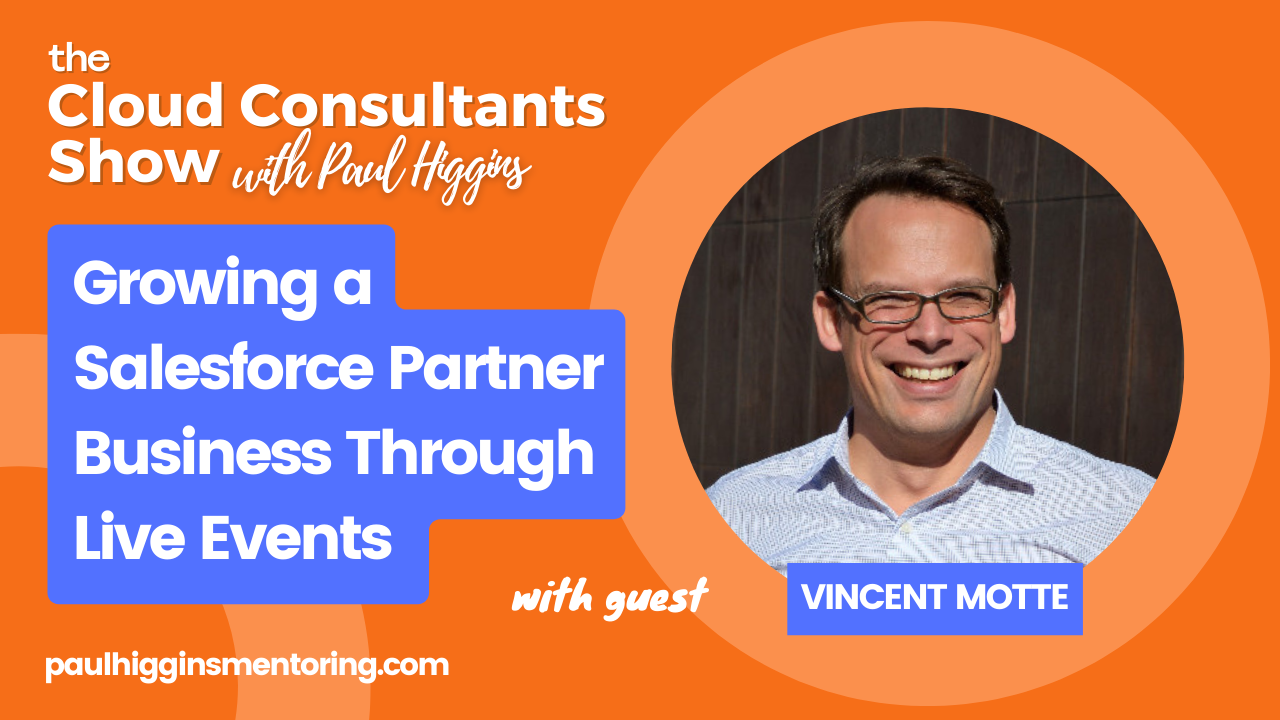


480 - Growing a Salesforce Partner Business Through Live Events with Vincent Motte
Episode Overview
Are you looking for other ways to grow your Salesforce partner business? Have you tried doing Live events?
In this episode, Vincent focuses on running and growing a successful Salesforce partner business within the competitive ecosystem. He shares his experiences and insights on market approach, differentiation, marketing strategies, recruitment challenges, networking through live events, and so much more.
Key highlights
- Approach to market and competition within the Salesforce ecosystem. They highlighted their focus on specific industries, their organic client acquisition, and their collaboration with Salesforce to develop a unique value proposition.
- The importance of differentiating yourself in the crowded Salesforce partner market. They also shared their successful marketing strategies, including organizing events and workshops, publishing case studies, and focusing on face-to-face interactions. They also mentioned the challenges of running events during COVID and the preference for in-person engagement.
- Various aspects of running a Salesforce business, including recruitment challenges, time allocation, and the importance of networking with other partners.
- Strategies for growing a Salesforce partner business through live events. Vincent shared insights on picking the right verticals, organizing successful breakfast events, and the importance of investing upfront to support partnership growth.
About Vincent Motte
Vincent Motte (Mot) spent most of his time working for management teams to bring their strategy to life through technology. His reputation as someone who gets the job done has seen him take on game-changing projects across M&A, operations, marketing, technology, and innovation.
As a director of Sydney-based consultancy Carnac Group, He is also driven to build a team filled with passionate, switched-on people who are encouraged to challenge the conventional thinking of what it means to be a professional.
He aims to help his clients make confident investment decisions in technology and innovation and then partner with them to make them happen.
Resources and Links
Please note: This is an automatically generated transcription. There are typos and the system may pick words or whole phrases up incorrectly.
Intro: I’m Paul Higgins, an ex-corporate executive turned business owner who, for five years, struggled to grow a cloud Consulting business whilst battling a chronic disease. With the help of mentors and experts, I got the business model right, built a sales and marketing engine, and developed a high-performing team that ended in a successful exit. I received a kidney transplant from a mate, and now on my second life, I dedicate my time to helping other Cloud Consultants go quickly with less effort to enjoy life. Detecting an accent, I'm an Aussie working globally from Melbourne, Australia. I interview successful Cloud Consultants sharing their scaling story to give you inspiration and practical tips. I have dedicated experts for Cloud Consultants on the show to save you time and money by working with the right people. If you want to scale quickly with less effort to enjoy life, you're in the right place. Let's get started.
Speaker 1 (0:55): I'm Paul Higgins and welcome to the cloud consultant show, episode number 480. Today's topic is growing a Salesforce partner business through live events. And you're going to learn firstly, how to pick the verticals that you should play in and most importantly, how to match them where they're at. The second is breakfast events. So soup to nuts on breakfast events. And Vincent does a brilliant job on that. And the third one is why investing funds up front is the right decision to help you grow your partnership.
Speaker 1 (1:23): If you're a first-time listener, welcome. If you love what you hear, please subscribe. It's for cloud consultants. So if you consult and deploy on a cloud or a SaaS platform, you're in the right space. If you're a regular, thanks for your support. I love receiving those emails at paul at paulhigginsmentoring.com saying that you are a listener and the topics that you'd love to hear. You can get a full summary of the episode in whatever you're listening or watching at the moment. And you can also get the full transcript of paulhigginsmentoring.com/podcast.
Speaker 1 (1:56): And before we go on our interview with Vincent, I wnat to thank two sponsors, the first is the cloud consultants collective.It's the world's only revenue focused cloud collective. And it's effectively peers helping peers. Right. So I guarantee that you're going to get an answer quicker than if you go to Google or YouTube. And why don't you try me out and test it so go to the cloudconsultantscollective.com. And as Vincent's got a great plug as in the podcast as to why you should rely on peers. And then other one is a workflow academy. Are your top performers feeling overwhelmed by their workload? Do you worry about their performance and if it suffers so much that they may actually leave? We have an innovative solution that can help. We partner with Workflow Academy provide you with high trained junior talent to support your top tier talent so that everything stays on track to learn more about this game-changing solution. Just visit paulhigginsmentoring.com/WFA. The links will be in the show notes.
Speaker 1 (2:58): So our guest today is Vincent Motte. He spent most of his time working for management teams to bring their strategy to the life through technology. His reputation as someone who gets the job done has seen him take on game changing projects across M&A, mergers and acquisition, operations marketing and of course technology innovation. And as a director of the Sydney Australia-based consultancy, Carnac Group, he also is driven to build a team fulfilled with passion, switched on people who are encouraged to challenge conventional thinking of what it means to be professional. His objectives to help clients make confident investments decisions in technology and innovation and then part of it them to make it happen. It's my pleasure to now hand you over to Vincent Motte from Carnacgroup.com, episode 480. Great have you here Vincent?
Speaker 2 (3:47): Hey, great to be here.
Speaker 1 (3:48): It's always good to have a French born and speaking Australian on the podcast. I don't think I've had many of those. So well done. You're probably the first, but why don't we kick off with who your ideal clients are and what problems you love to solve for them?
Speaker 2 (4:04): Yeah. So we have specialised in specific industries. So first of all, ideal clients come from this industry. So for us, it's construction, property, manufacturing and consumer goods, typically. The way we like to say it is ideal clients, they either build an asset or service an asset or their manufacturer product and move that product around. So that's probably the starting point. And then of course, there's a size of client that works better for us. So we’re targeting the highend of SMB’s, Small-Medium Business, we’re targeting mid-market GB and enterprise. So typically we look at clients who are already a little bit sophisticated, that already have some understanding of technology, strategy and implementation as well.
Speaker 1 (4:47): Yeah, great. And they've normally got deep pockets but sometimes hard to get into pockets.
Speaker 2 (4:51): Oh, look, I wouldn't say that all our customers have deep pockets. We also work with customers with DAWT and you do have to maximize the investment carefully. So we do work quite a bit in SMB where we might do a $20,000 implementation and have to deliver as much value as possible within that amount of money as well.
Speaker 1 (5:10): Yeah, well, if we take construction and property for the moment, now what are some of the key problems you're helping to solve there?
Speaker 2 (5:17): So there's probably two aspects. So property and construction are a little bit different to some extent. So in construction, we work with head contractors, typically all subcontractors, Civil Construction businesses. And the problems can be as simple as, you know, we need to be able to track attendance, which is the typical entry point of Salesforce, but we go way beyond that. So some of our customers manage planting equipment using Salesforce to manage safety, they manage contract administration, time sheets, they subcontract on boarding and all sorts of things that you wouldn't think Salesforce could do. So that's the sort of things that construction businesses can do in property. It's a little bit different. It's the typical things of, are you setting a home? Are you setting an apartment? Are you a land developer? Are you a shopping center developer? Do you need to run a shopping center? Do you build to rent or build to sell? So there's lots of problematics, but they typically all revolve around one thing. It's the customer experience. So going from, I'm inquiring and I'm trying to search a bit of information about what you're selling or a house that you sell or a package, to I'm getting the keys of that house, essentially. So it's trying to streamline that on-time customer experience to manage the workflows internally and to have one source of truth to consume information in a business. So whether you're a home builder or land developer or a hard-rise builder, the overall objective is always the same.
Speaker 1 (6:37): Yeah, and you've talked about the fact that, you know, you want your clients to have some form of physical product, right? That's important. Why in particular have you chosen both construction and property as verticals to focus on?
Speaker 2 (6:48): Yeah, good question. We don't choose sort of, you come from this industry and therefore it makes sense. And I'll tell you the story. So I used to work for a large-secs business that was working across manufacturing and construction. And I used to have Salesforce in my list of products that I was managing or project that I was managing. So that was back in 2012 and 2013. That's the first time I touched Salesforce to only end user's side. And I always told you I'll come back to that product because there's a lot more potential than just sales effectiveness and a bit of marketing. So coming from this industry is that meant that when I found a Carnac Group, I wanted to be laser focused on industries that I knew well. So we could actually go to those customers, not as a technical partner because quite frankly, every partner that you've interviewed could do exactly the same thing. We're not better, we're not worse, we're just the same. But being a technical partner is not a great value proposition. So our value proposition is we come from this industries, we've recruited people from this industries, we come to our clients and we actually help them because we understand these industries. So we're not there trying to push Salesforce everywhere, we're just there to make sure that their business is better off with technology and Salesforce being one of them.
Speaker 1 (8:02): Yeah, yeah, great. And within those industries, you know, who's your biggest competitors, who you're coming up against from either other platforms or not platforms?
Speaker 2 (8:09): So I guess from a partner ecosystem, we're pretty lucky because they’re not the industries of choice for most partners. So if you're a partner, you want to grow quickly, you're going to tap into government, you're going to tap into finance, you're going to tap into those industries or perhaps education or this sort of industry's construction and property no one wants to do it, I feel, because it's hard, that's as simple as that. It is difficult. They are industries, they're known for low pricing and the low prices, the ones that wins and this sort of thing. You really have to handle this industry differently. So from a partner perspective, that essentially means that yes, we do compete sometimes but we rarely lose in those sectors. It's really rare for us to lose or if we lose that would be just purely for pricing and that's probably better if we don't do that project essentially.
Speaker 1 (8:58): And just for those who missed the intro, you might be coming in a little later that, Vincent is working under the Salesforce ecosystem, right? So when you're talking about partners, you're talking about other partners within the Salesforce ecosystem. And as far as any other, do you come up against, you know, like, um, I don't know, you know, other platforms like Zoho or HubSpot or someone else in this, this place may be, you know, NetSuite could be another one.
Speaker 2 (9:24): Yeah, look, no different to any other industries quite frankly. So far as we compete against Microsoft, that makes very often that's a pretty logical, compete, essentially, because they, they're platform players. Well, in the marketing space, yes, we are competing against Adobe or we are competing against HubSpot. And that's fine. Pulling the ERP space, not so much. So, you know, like, if you think about a NetSuite, they don't really play that strongly in that CRM space anymore. So they're very strong in their ERP back end and this sort of things that we have a lot of customers that do have NetSuite and Salesforce and that usually is actually a good combo, right.
Speaker 1 (10:00): Yeah, yeah, yeah, yeah. I agree. I still haven't met too many people that say I love NetSuite, sales or marketing tools.
Speaker 2 (10:08): Yeah, it's not going up here.
Speaker 1 (10:10): Yeah, it's, well, anyway, my view should have stuck to what it's best at, but that's not always the case. Your investors don't always want that or the public investing in your company. And so when did you actually start the Carnac group?
Speaker 2 : (10:27): So Carnac group was founded in 2017. That's when we became a Salesforce partner and we actively started to trade in 2018 essentially. So it took us a few months to put everything together. And yeah, we really started actively in the ecosystem in 2018.
Speaker 1 (10:44): Great. And I think now what you've got about 30 in the team?
Speaker 2 (10:46): Yeah, 30 people. Started with just three, and now 30.
Speaker 1 (10:50): Yeah, we’ll sort of go through that journey. But I suppose when you first started, like you said, you've used the product within company, within corporate, you saw the full value of it, you decided to go out and start your own. Where did you get your first clients? What was your first path? I know the industry, you chose the industry, but how did you actually get your first clients?
Speaker 2 (11:13): Yeah, so actually the first clients that we got actually organic. So we found them ourselves, we didn’t rely on Salesforce at all at the beginning, quite frankly. So we obviously had a network, we knew a lot of people in the market, and we’re looking for partners or chance partners at the time anyway, so we managed to get quite a few contracts that where in the beginning without understanding the Salesforce machine and how to interact with that machine. So yeah, we got quite a few, like I would say, SME customers at the time, maybe a few larger ones as well. And we got an enterprise customer in the first year that helped us to pretty quickly, but at the beginning, it was 100% organic essentially.
Speaker 1 (11:52): Right, and who was wearing the sales hat?
Speaker 2 (11:54): So we’re only three in the business and we had, so essentially sales, which was me, we had a marketing person as well, so we spent quite a bit of where the strong focus on marketing as well, and we had one technical architect, that's all we had.
Speaker 1 (12:07): Great, and the marketing, what were the type of things that worked the early days from a marketing point of view?
Speaker 2 (12:13): Communicating about what we were doing, the work we were doing, the success with our customers, that was the key thing at the beginning, positioning our capability as well, making sure that our capability statement was really clear, that we had a good story to tell essentially, so the marketing was really focusing around that at the beginning. And today, a look at kind of group, and we 30 people, but from a brand perspective and an overall recognition in the market, we recognize, you know, probably one of the top partners in that space.
Speaker 1 (12:42): Yeah, yeah, great. Well, look, I've said to you, who you're a regular listener, that, you know, picking a vertical is the right thing to do. I know that, you know, Vincent's got three, but you can tell, you know, he's got knowledge, the main knowledge from that industry just makes such a difference. And, you know, was there any particular channels that you marketed on? Was it, you know, website, SEO, LinkedIn, a combination of all of those? Where were you actually putting this material out?
Speaker 2 (13:08): Yeah, probably nothing online, quite frankly. I mean, you, you have to think that those industries, especially construction, property, and manufacturing, they're pretty much face-to-face industries. So, you know, you need to meet people, you need to shake hands. So a lot of our work in terms of go-to market was actually meeting with companies directly attaining exhibitions, like, you know, Sydney Build Expo, for example, in the construction industry or the manufacturing, export manufacturing. So being visible in that sort of space, the online presence was almost irrelevant to us, quite frankly. And then probably at the back of 2018, we started to understand how the Salesforce machine was working. So we spent a lot more time engaging with ease and the sales directors there to make sure that they understood what we were doing, when to engage us and when not to engage us as well.
Speaker 1 (13:52): Yeah, well, perfect segue into that. Right. I suppose take us to know what you first started doing, and is there any difference in the way that you're actually working with Salesforce? Because I think roughly about 60% of your lead sources through Salesforce?
Speaker 2 (14:06): Yeah, 60 to 70%, depending on the period. So yes, the way we started is quite different to the way we operate now, because we started really working through our networks and, you know, identifying opportunities in our network. And that takes you, you know, quite far. And I think from a Salesforce perspective, that's the right thing to do as well, to identify your own opportunities. And then in 2018, we started to work a lot. more closely with Salesforce, especially around those industries that we had. Probably for one key reason is that Salesforce didn't really understand those industries either. So Salesforce was focusing on the big retail and the finance and the government, and we were focusing on industries that they had no point of view on. So to some extent, we could develop a point of view, present a point of view, and go to those days saying, look, this is how those industries work, this is what we can do, this is what we can’t do. So essentially, we helped them to develop a bit of a talk track for their prospects and their white space. So we helped them really early on, we even helped some BDRs well to develop a bit of a communication plan and specific bullet points that they could talk to in this industry. So that really helped to be visible at that stage. And I think the main difference is we were not going to Salesforce and give us some lead, which is a big mistake. We were going to Salesforce saying, this is what we can offer to you and help you with as a starting point. Then the leads may or may not come to us. That's a different story. But we went there with trying to bring values straight away to the AEs as opposed to just asking them what's your patch.
Speaker 1 (15:37): Yeah, yeah. I think that's so important. It's hard because you want growth in your business. You really, if you're the owner, like Vincent is, you're really keen to get those sales and see the revenue growth. But don't burn your bridges too early. I think you can add value and be different, like there's so many of you, Salesforce partners. I don't even know how many totally there is in the world. But just don't be like everyone else, which is why Vincent's growing quickly from 2017 or 18 to now with 30 people. So that's worked well. Has there been any other, so let’s call it the 30%, is there any other marketing activities you do or any other sales activities you do that are helping bring in leads?
Speaker 2 (16:20): We run a lot of events these days and that's typically our preferred channel to create leads and nurture prospects as well. So we attend exhibition a lot so we're visible in all these markets. We organize a lot of workshops, we have a lot of our customers speaking at breakfast, for example in Brisbane and Sydney. So we try to be visible to make sure that aids can bring their prospects as well so they hear the stories of our customers. So that's probably a major focus in terms of marketing these days. We spend a lot of time publishing case studies, doing videos as well for showing the success of some of our customers as well. So we probably our marketing as is a lot broader these days because we do internal marketing at Salesforce, we do external marketing which is case studies, videos and all these sort of things. We do marketing with our existing customers, with existing prospects, and we do events as well. So it's pretty broad. The only thing that we don't do much is social media.
Speaker 1 (17:18): Yeah, great. And just touching on the events and especially the breakfasts, right? Just take us through. I'm sure you've tested different formats of what works well and what doesn't. What's your format? Let us in on a bit of a secret as to how you've got them working now and what works well from a breakfast point of you?
Speaker 2 (17:34): Yeah, so we've tried quite a lot of things quite frankly. But the format that's probably the stickiest and the most valuable for prospect and people that are attending in general is when you've got one key customer who can actually talk through their journey. And not in the polished way or marketing way or the beautiful story where everything's beautiful is actually being really truthful and transparent about the journey. So typically starting with that, a customer telling this story is actually really good and what worked, what didn't work, how did they approach something, how much money did they spend, all these sort of things are really important. And then typically what we do, one of our organizers, breakfast is we might do a presentation around how can you be successful rolling out Salesforce, so how should you support Salesforce, so what are the traps of projects, how do you conduct change management. So we pick specific topics, that Salesforce typically will not talk about too much. Salesforce will talk a lot about the products and the amazing things you can do that's great, we talk about how to actually do it, how to implement it.
Speaker 1 (18:37): Yeah and how many people would attend breakfast, like what's a good turn out for you?
Speaker 2 (18:40): Yeah, we try to keep them small, so typically 20-25 is what we want. We want a small audience, we want people to network and to talk to each other, that's really the overall idea, so yeah, smaller audience price is always preferred.
Speaker 1 (18:53): Yeah and I know you're in one of the best cities in the world, Sydney, Australia. But it doesn't matter, everyone's clock is the same at some point. So, you know, what times work best for you? Is it, you know, seven in the morning? Is it nine? Like, what sort of times?
Speaker 2 (19:07): Yeah, so it's going to depend on cities. So Brisbane is typically a bit earlier. Sydney is an 8:30’s fine, works well. Melbourne is probably the same in 8:30 as well. So it depends on cities. Some of the year, it's always hard to tell, but, you know, not November, December, it's usually too late. So anywhere between March and October seems to work reasonably well.
Speaker 1 (19:26): Great. And how long do they typically go for?
Speaker 2 (19:29): Oh, an hour and a half max then.
Speaker 1 (19:31): Yeah, great. And what sort of the follow-up sequence post the meeting?
Speaker 2 (19:35): It's a good question. And it really depends on who is attending. So often we're going to have a crowd that's made of existing customers. And if it's an existing customer, we're not going to follow up because they're not there to, you know, because there's a new opportunity or anything like this. They're actually just interested to understand what other people are doing. And it's good networking, they meet with other customers and other prospects. So no for those ones typically, maybe just a survey to ask them, how it went and did they like it? And then there's a list of typically prospects. Some of them are in our pipeline already. So we leave the salesperson to continue the journey with the opportunity. And then there's what we call planting the seed. And they're the long-term prospects. The prospects, it's gonna take you two years to convert them potentially, but you still invite them to this event. You still have discussions regularly and all that, but you don't force a sales cycle on them because it's not the right time. We've had quite a lot of our large projects that we've signed where the prospect came to the first breakfast and the second one, and the third one in two years. And then they become one million dollar project. So it does happen. And it's certainly our strategies to plant the seeds and, you know, to not bombard them with a sales process because Salesforce does it already. So they don't need us to do that.
Speaker 1 (20:52): Yeah. And are you videoing the clients when they speak?
Speaker 2 (20:54): No. No.
Speaker 1 (20:56): Is that for a particular reason?
Speaker 2 (20:58): It's either you come or you don't know about it. So you have to come face to face. Otherwise, you know, otherwise people will just stay behind the screen then.
Speaker 1 (21:06): Yeah. Great. And the frequency, like how often a year are you running these breaks?
Speaker 2 (21:12): I wish I could do it every three weeks or something like that. But the reality is we have to be really careful because Salesforce is also running a lot of events. So we want to make sure our events are not happening at the same time. Typically one every month or two months is the ideal timing, but there's always time of the year where it's difficult. So February is very often a write off. April is a write off because of Easter. So there's a lot of reasons why it's difficult to maintain that cadence. But yeah, once every two months is probably about right.
Speaker 1 (21:45): And during COVID, did they not happen? Or did you do them virtually? What sort of happened during COVID?
Speaker 2 (21:50): Yes. So during COVID, we actually moved some of those sessions online. And we did two formats. We did a format that was more the webinar-like format where we were showcasing specific use cases or how Salesforce could be used to do one specific thing. And that worked ok at the beginning of COVID. I think they were the novelty of logging into a webinar and learning something. And that was all fine. And we found that after six months, it sort of dug down and the webinar attendance was pretty low overall. So we sort of stopped it and said there's no point putting all that effort for, you know, for 15 people to turn up on the webinar. It didn't make sense. So we stopped that. We turned to interviews where we did a lot of customer testimonials instead. A bit like what we're doing today. And where we had our customers, you know, doing a bit of an interview with us and, you know, for half an hour. And we were publishing that online. That's been reasonably successful as well. Really good for the Salesforce folks as well, to be able to listen to this interview. So we've done a little bit of that. We don't do it anymore as much, quite frankly. But that's the sort of things we tried doing, doing COVID.
Speaker 1 (22:56): Yeah. And the reason you don't do it, is just because of the busyness of the business or just, you don't think it was working?
Speaker 2 (23:03): Look, you can't do everything. That's how we look at it. And for the industry that we work in, the face-to-face is the way to go. You want to see people in the eye. You want to be able to, you know, shake hands. You want to be able to introduce them to other customers and other prospects. For us, you think you've got a limited budget for marketing and a limited bandwidth to get things done, then we would privilege the first to face first.
Speaker 1 (23:27): I think it's really smart. Like A, you've identified giving your industry knowledge, et cetera, which verticals the play with, which I think is really smart. Then B, it's where those people, well, how they like to communicate and work. So you're matching them where they're at, which once again, if you're listening to Vincent, your client might be completely different. So in-person events may not work for you. It might be something else. It might be live webinars or whatever, especially if you're in the US where there's a lot of dispersity of where people are, it's hard to get people together. So just match them where they're at is. I think the key thing out of this, if we pivot a little, we've spoken a lot about the sales and marketing effort, which has gone really well. What about the team size? Right? Now got to 30 people, which is fantastic. What’s been the hardest role to hire or hardest person bring on so far?
Speaker 2 (24:19): Yeah, that's a good question. I don't actually have a good answer for that because I'm not too sure. I mean, we struggle of course, like everyone else during the COVID period to just attract people and to retain people, like every business, quite frankly. We haven't found specific rules that were harder to recruit for. It was all okay. It was just about setting expectations in terms of salary range and, and why people would move to a smaller business like ours. So that was more our story to sell that we found was the challenge at the beginning. But yeah, no specific role. We've always found, you know, whether it was a developer, whether it's a functional consultant, whether it is an architect, we've always been able to find the right people for our business.
Speaker 1 (25:04): And, you know, it was a rough, rough week. Now, where do you spend your time? If you had to sort of put it across, whether it's by functions or by activities, you as the owner of this 30 person business, where you spend your time?
Speaker 2 (25:16): Most of my time would be spent in the market. So probably 60% of my time is in markets, talking to customers, attending workshops and talking to Salesforce AEs and talking to different people at Salesforce, of course and attending events. So probably 60% of my time is on that. And then probably 20% is on delivery, making sure that projects are going the right way and that if there's any problem or something to resolve that I can resolve it. So maybe 20% of my time is spent on that and the 20% would be on admin and finance and forecasting and pipeline and all these sort of things.
Speaker 1 (25:56): Yeah, yeah. And it's sort of bringing back a bit of my past, but you know, do you have an assistant? Do you have anyone supporting you in your role or how do those 30? How does that sort of get structured?
Speaker 2 (26:09): Yeah, no. So we build a team that's reasonably with strong people. So we've got some strong leaders in the business, in delivery. We've got, you know, a great national engagement director. We've got a great project service director. We've got a great technical services director, also a co-founder of Carnac as well. So we've got a strong management structure in delivery that allows me to focus on different things and they let me know when they need me. So I don't have any assistant or anything like this. You know, everyone is just taking some of my workload to some extent and that's about all.
Speaker 1 (26:44): Yeah, great. Well, what we're going to do now is go into the rapid fire where we'll finish off with four key questions. You're going to give me rapid fire answers. You're ready for that?
Speaker 2 (26:53): Yeah.
Speaker 1 (26:55): Let’s do it. So the first one is for you. You've sort of talked a bit about where you spend your time. But what are some of the daily habits that you do to help you scale Carnac Group?
Speaker 2 (27:05): The first thing is the two minutes rule that I use all the time. And that's if something takes less than two minutes to do it now. That's what I do every day or trying to do every day that avoid procrastination. And quite a bit, in fact. So that that's probably my, my main rule. And the second thing is always challenge what you're doing now.
Speaker 1 (27:23): Yep. Brilliant. And the next is where do you find out more information around how you grow your salesforce business?
Speaker 2 (27:29): Talking to other partners, quite frankly. That's the best source of information is you talk to other partners who went through that cycle before you. And sometimes they're competitive. Sometimes they're not, but doesn't really matter. I found that's the best source of information, quite frankly.
Speaker 1 (27:43): And how do you reach out to them? Like where are you finding these other partners?
Speaker 2 (27:46): Oh, look, Salesforce is very good at organizing a lot of partner forums and partner events and all this sort of things. So, you know, we, we probably see each other every quarter, all the different partners every quarter. So it's actually quite easy.
Speaker 1 (27:58): Yeah. And a shameless plug, if you want to see or meet partners more regularly than that, just go to the cloudconsultantscollective.com because we've got lots of Salesforce partners in there that can work with and help you at any point. Peers helping peers. So the next one is if I could grant you one wish for the Carnac Group, what would that be?
Speaker 2 (28:17): I think that would be unlimited money to develop the business, you know, like growth in new regions like New Zealand and you know, WA and going to the US and going to Europe to expanding the brand everywhere else as quickly as we can. That's what I would want to do.
Speaker 1 (28:31): Yeah, great. Well, there's definitely lots of the three classes or the three verticals you focus on everywhere in the world. So if you're in that, those verticals and you're listening and you think, Oh, actually, I could, you know, work both in different geographies with Vincent, reach out to him. The last one is what you know now, right? So you've been in 2018, you started. Now is 2023, if you're listening to it when it's released, what have you learned and what do you know that you would have done probably different or would have done differently for sure that you already know now?
Speaker 2 (29:10): Yeah. The first thing is we would have invested more funds in the business on day one. We've created the business with $5,000. That's all. And we've never injected any money whatsoever in that business. It's just been self-funded. And realistically you're limited by that pretty quickly. So I think bringing other investors or bringing more money in the business would have fast tracked that growth. You know, we would be much bigger today for sure. That's probably the first thing. So, you know, creating a partner in a business with limited fund is difficult. It's a real challenge. And all you've got is your energy essentially. And probably the second thing would have been to really fast track our understanding of the Salesforce ecosystem, of the relationship between partners and account executives and partners and directors and VPs at Salesforce. We spent quite a bit of time not really interacting with Salesforce at the beginning. So to some extent, we've probably wasted a year at the beginning, not really understanding how it all worked. And that's probably because I was just a newbie in that world. I was coming from an end user background, another consulting background. I've never done sales before either. So I think it would have done a better job at interacting with Salesforce, probably recruited strong salespeople on day one faster as well, like these type of things.
Speaker 1 (30:28): Yeah, great. Well, look, you've still done a brilliant job in the time period that you've had. The sort of circle five years, you've done a great effort. And we're listening to Vincent Motte. But brilliant having you on Vincent. Well done for what you've created. And as I said, you're my first French born, French speaking Sydney Salesforce partner on the show. So congratulations for that.
Speaker 2 (30:52): Thanks for having me, Paul.
Speaker 1 (30:53): All right, brilliant. Thanks.
Speaker 1 (30:54): What a great interview with Vincent. I love these two-minute rule I once learnt that when I was at Coca Cola and I think it's such a fantastic thing so go and apply it. If you can do it within two minutes, do it. Don't keep adding to you to do list. Also I love the fact that he's got a great combination of 70% salesforce so he really leverages the salesforce ecosystem to an AEs to get leads but he's also got his own especially in those events as well. If you want to know more detail of that, reach out to Vincent on LinkedIn and also you know if you've learned something really valuable please post it on LinkedIn and at mention Vincent. And if you've got some peers as Vincent said it's so valuable. If you've got some peers that can learn from this or have talked about this running live events, etc., and they can benefit from it, please share it with them. They'll think you're a rock star. Don't forget to check out our solo shows. Also, if you're scaling your cloud consulting business and want a great book on the things that you should be doing, right? You may be doing all of them, but who knows? Why not go check it out at paulhigginsmentoring.com/blueprint and get your free copy today, and please take action to grow with less of it and more reward.
Outro: Learning is just one piece of the puzzle. it is now time for action. Head to Today's show page at paulhigginsmentoring.com/podcast, get the links, and put it into action. Head to your favorite podcast platform, subscribe, rate, and review the show. Suggest topics for me to cover at [email protected], and don't wait one more minute to gain access to content, especially for you, a cloud consultant at paulhigginsmentoring.com/newsletter. This could be the difference between wasting time figuring it out yourself or scaling quickly with less effort to enjoy life.